Emigrants’ homelessness at sea
The EmigrantsEmigrants’ homelessness at sea names the precarious condition of the passengers on the Charlotta after they have left Sweden but before they can establish homes in North America. It is more than the absence of a house: separated from the stable ground that gives home its meaning, they occupy a narrow vessel that is at once their refuge and a reminder that they have not yet arrived anywhere. The return of a Swedish ship makes their departure newly real, and the drawn-out passage leaves them suspended between a home they have deserted and a destination still beyond reach.
From settled hamlets to departure
The state begins in the contrast between the old communities and the imagined land across the ocean. In the peasant hamlets, plots seem to shrink as families grow; food is scarce, while inherited customs make familiar life feel stable even when it offers little prospect of improvement. News and rumors of fertile American soil circulate from neighbor to neighbor, gradually unsettling communities long accustomed to remaining in place. Yet the ocean and the distant land are unknown, and the choice divides the cautious from those willing to risk departure.
The passengers do not leave for one identical reason. Their group represents several pressures that converge in a shared migration: crop failure, persecution by civil authorities, religious dissent, personal problems, social ostracism, and unfair employment practices. For Karl Oskar Nilsson and Kristina Johansdotter, the decision is also grounded in the household’s worsening prospects. After four years at Korpamoen, they are several hundred riksdaler poorer; continued labor seems likely to end in exhaustion and a reserved room with only meager bread to show for it. Their different attachments and judgments do not disappear when the journey begins, but departure gathers them onto a common route.
The collective journey takes shape
The move from private decision to group passage depends on practical arrangements as well as aspiration. Karl Oskar Nilsson and Robert Nilsson arrange passage with a firm in Karlshamn and pay a down payment of one hundred daler for six people aboard the merchant vessel Charlotta. They plan to embark in the second week of April and sail directly to New York, without calling at an intermediate harbor. Spring offers a narrow practical advantage: the winter storms have passed, and arrival should leave time to till and sow before the autumn harvest. Robert Nilsson is also to seek a passage contract for Danjel Andreasson if the ship has room, extending one household’s plan into a larger movement.
At Åkerby Junction, that movement becomes visible as a group. Danjel Andreasson arrives with his wife, four children, and Ulrika of Västergöhl; Jonas Petter of Hästebäck drives his own wagon, with Arvid and Elin among those who ride with him. The emigrants total sixteen—nine adults and seven children—while three drivers are to return from Karlshamn. The gathering does not erase their separate circumstances, but it gives departure a shared shape: people with different motives now travel together toward the same ship and uncertain destination.
The road itself is a threshold rather than a clean break. Robert Nilsson jumps down to open each gate, counting five before Åkerby Junction and treating even winter-opened pasture entrances as gates on the road to America. His counting turns a practical task into a measure of the passage ahead. Meanwhile, Karl Oskar Nilsson and Kristina Johansdotter sit silently in the wagon, attending to familiar places they believe they will see for the last time: a brook with a swimming hole, a meadow where lilies of the valley bloom. Their attention holds the old home in memory even as the wagons carry them away from it.
The ship as shelter and confinement
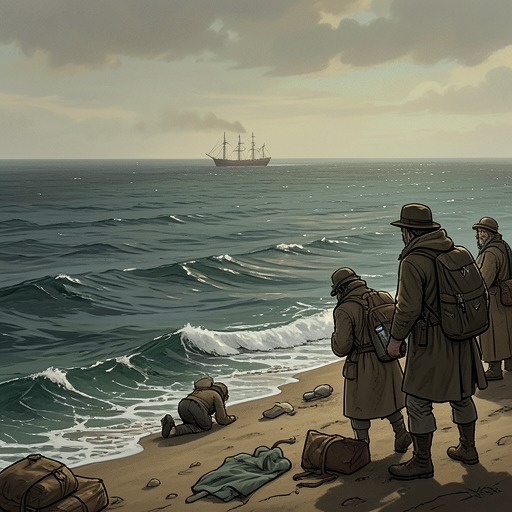
At the coast, the emigrants encounter water with no land visible on the far side. A cold wind blows from the harbor, cutting through their clothes as they face the sea they must cross. The first encounter sharply changes the scale of their journey: the familiar roads and fields have ended, while the ocean offers no visible foothold or assurance of a safe arrival.
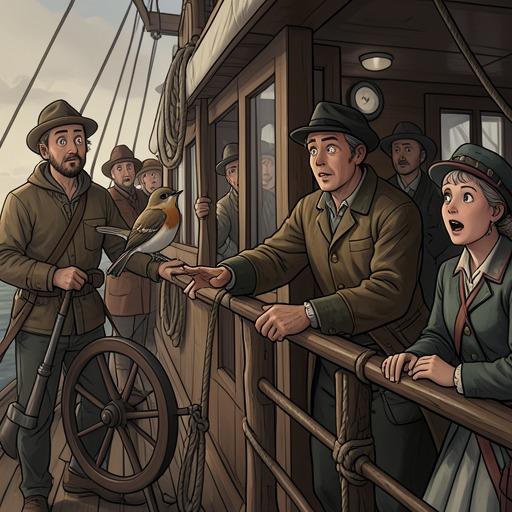
The Charlotta gives them shelter, but its dimensions make that shelter feel fragile. Robert Nilsson and Arvid inspect the brig and pace its deck, estimating it at forty paces long and eight wide. That limited space is meant to serve almost a hundred people for movement, sleep, meals, and bodily needs. The passengers’ refuge is thus also a place of confinement: the same small vessel that carries them toward a new home must contain their daily life throughout the crossing.
The ship’s material limits deepen the uncertainty. The emigrants notice that the rafts on deck do not seem sufficient for everyone, and even ordinary arrangements aboard are puzzling to Robert Nilsson, who has to ask where the outhouse is. His inspection registers the difference between life ashore and life at sea through measurements, unfamiliar terms, and practical questions. For people accustomed to fixed houses and land, the vessel offers no equivalent of a secure cottage with solid walls and locked doors.
The return ship and the loss of home
When the emigrants meet a vessel sailing in the opposite direction, the Swedish flag on its stern makes home seem suddenly close. The ships pass only a few hundred yards apart, and the passengers imagine that the other vessel might carry people from hamlets like their own, perhaps even someone they know. But the two ships embody opposite movements: one is returning to Sweden, while the Charlotta continues away from it.
The encounter exposes a contradiction in the emigrants’ sense of belonging. They still think of Sweden as home, although they have deserted their former homes in search of new ones. They have left the cottages and communities that made home familiar, but the American destination has not yet become a place where they can settle. They are therefore seekers of homes who, for the duration of the voyage, possess none.
The Charlotta itself becomes their temporary earthly refuge: a brig only forty paces long and eight wide, surrounded by an ocean that expands beyond sight. At night, the waves rise around the ship and make its shelter feel vulnerable; the passengers must entrust themselves, their lives, and their belongings to its planks. Their customary idea of home—a peaceful, stable place on ground, with sturdy walls, closed doors, and secure locks—belongs to the land they have left, not to the restless vessel under them.
The Swedish ship gradually shrinks to a gray speck and disappears in the direction from which the emigrants came. Its departure does not merely remind them of Sweden; it makes them feel more strongly that they are sailing away from it. The return passage transforms a distant separation into something visible, while offering no corresponding evidence that a home is waiting ahead.
Distance, delay, and suspension
As the voyage continues, time at sea becomes a measure of distance. Contrary winds, currents, and fog delay the Charlotta, and the passengers grow suspicious that North America may be much farther away than they were told. They count not in miles but in the days they have spent aboard since leaving in the second week of April. Their homeland grows incalculably remote, but the new land remains remote too; movement has not yet delivered them to belonging.
After two months, the emigrants have seen only one other ship since the English shore disappeared and they entered the open sea: the Swedish vessel sailing home. They have endured storms and seasickness, yet encounter no human life beyond their own ship. This isolation gives their homelessness a wider scale. They imagine themselves as the only people crossing the ocean, forgotten by the world, and cannot know whether anyone in Sweden still misses them or anyone in North America awaits them. The crossing is thus not a simple passage from one settled home to another, but a prolonged interval in which the old home recedes, the new one remains uncertain, and the ship bears a community of people still without firm ground beneath them.